
Beat Soundtrack #39: Jack Walters
Author's very own song by song...

JACK WALTERS is based in the South West of England and is a staff writer for Pop Matters, where he has interviewed Greil Marcus and Dion DiMucci. ‘Mainly,’ he says, ‘I write album and book reviews. Most recently, I penned a review of the British author Michael Bracewell’s brilliant latest book The Smiths: A Novella. Last year, I wrote a long-form article on the 50th anniversary edition of Marcus’ classic text Mystery Train.’
He contributes to the Pop Matters series ‘All Things Reconsidered’, writing retrospective pieces on Patti Smith’s first B-side ‘Piss Factory’ and Leonard Cohen’s album New Skin for the Old Ceremony. In addition, his essay, ‘The Philosophy of Rough and Rowdy Ways World Wide Tour’, is published in The Dylan Review.
Further, Walters has lent his name to a sequence of linked titles issued by Fonthill. He published his first book Bruce Springsteen: Song by Song in 2023 and released Bob Dylan: Song by Song, Volume 1: 1962-1969, which R&BG wrote about earlier this year. Two more Dylan overviews are in the pipeline: volume two covering 1970-1983 and volume three charting the years 1985-2020.
_______________________________________________________________________
What attracted you to the Beats? When did you first encounter them? Do you have a favourite text, novel or poetry?
At 19, I read Allen Ginsberg’s ‘Howl’, Kaddish and Other Poems – it was like a dagger to the heart. It didn’t express anything you didn’t already know, but rather said things about mankind that you would mumble to yourself when catching the bus or watching the news: wicked and avaricious, selfish and violent, oppressive and power-hungry. Stuff like that.
Ginsberg was a brave poet who wasn’t afraid to voice the dark and ugly side of the United States. He had a Whitmanesque scope and a Blakean vision; it always felt like the spirit of St. John of the Cross watched over him as he wrote.
Then I went on to read Jack Kerouac, another revelation. He travelled around the United States as if it were the nine circles of hell with kindred spirits, all of whom lost their minds before, during, or after the peregrination; they were mad because they were enlightened, enlightened because they were mad, seeing through Man and eternity and beyond. Wherever.
Kerouac went on the road to find or know nothing, which is to say to experience the present moment, the eternal now. Like a twentieth-century Horace, Kerouac understood the brevity of life.
From this came a carpe diem approach to life, resulting in fun and havoc. But there was always a sadness to Kerouac, a sadness behind the madness, a sadness which Neal Cassady grabbed and threw away from him. Put differently, Cassady was the antidote to Kerouac’s ennui (see how many times he uses the word ‘sad’ in On the Road), reminding him to grab life by the horns, to be ‘the enemy of the unlived meaningless life,’ to quote Bob Dylan. Of course, though, Cassady was also running away from his own sadness.

Pictured above: Author Jack Walters ‘searching for Byron’, Venice, 2024
What most appealed to me was the Beats’ épater la bourgeoisie, or to shock the middle class. It was like they had set off a bomb in the literary establishment and watched the fallout with impish grins. Moreover, it was as if Arthur Rimbaud had been resurrected and found himself in the consumer-driven culture of mid-century Eisenhower America.
And then, seeing the mindless consumption and McCarthyism, thought, Merde! Merde!, I’m putting my queer shoulder to the wheel. The Beats reached back to Ezekiel and then catapulted their ideas to the future with mad glee. Ginsberg was, of course, hugely influenced by William Blake, whose favourite part of the Bible was the Book of Ezekiel and was particularly inspired by the imagery of Ezekiel’s Wheel.
My favourite Beat poem is, arguably, the least typical Beat: ‘8’ from Lawrence Ferlinghetti’s A Coney Island of the Mind. The Apollinaire-esque poem tells the story of a married couple having a stroll through a meadow in Golden Gate Park before relaxing on the grass. But you feel a palpable distance between them.
While the husband is asleep, the wife gazes at him with ‘a certain awful look of terrible depression’. It could be an Edward Hopper or a Giorgio de Chirico painting; the metaphysical distance between humans and within ourselves.
What is the relationship between the Beat writers and music? How do you think that literary scene and musical sound connect(ed)?
The Beats influenced rock, for sure, along with the lifestyle of being on the road and everything that comes with it: decadence, wildness, weariness. As you know, they had progenitors in the enfant terrible figures of Jean Genet and Henry Miller, who harkened back to les poètes maudits: Rimbaud and Paul Verlaine – not to mention going further back within that century to Thomas De Quincey. In any case, you cannot separate the counterculture of the late 1960s from the Beats.
Through their writings and spoken word, the Beats influenced the way musicians converged rock’n’roll with poetry, including a Beat-like accentuation and nonchalance.
For instance, Lou Reed’s laconic and insouciant delivery, where he seems as if he is above or under the words – too hip and cool for the dead bodies stacked up before him and, instead, focused entirely on a great big clipper ship. ‘Heroin’, to which I am referring, depicts the eternal as the prosaic, the prosaic as the eternal, not unlike the works of the Beats.
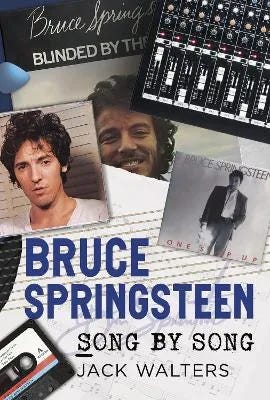
Pictured above: Walters’ 2023 book on Springsteen’s song catalogue
As a music writer have you been shaped or influenced by Beat experiences?
The Beats wrote with an unflinching honesty and an irreverence, which I adopt myself, especially when writing record reviews. Let’s not take a 600-word record review too seriously – or seriously at all. It’s not the Magna Carta. Who gives a shit what I think?
If a reader takes my words seriously, I would tell them to read Rosa Luxemburg and Julian of Norwich, writers who have an abundance of wisdom. Remember too that Kerouac was a great music writer. Read the passage on George Shearing playing at Birdland in On the Road, and you could be reading Nick Tosches’ biography of Jerry Lee Lewis, and vice versa. Writing is a bit like like ping-pong.
Which musical artists from whichever era appear to make links to the Beat Generation – and how?
Bob Dylan, of course. The influence was most prevalent and overt from 1963 to 1966, evident in his words, cadence, and diction; the best example of this is ‘Subterranean Homesick Blues’. The Beats are a foundational text for him, which is likely why Ginsberg, Gregory Corso and Kerouac are namechecked in his 2020 song ‘Key West (Philosopher Pirate)’. However, Dylan is, first and foremost, influenced by music: rock’n’roll, minstrelsy, country, country blues and old-time music.
Other musicians/bands carrying the Beat torch in one way or another, small or large, unknowingly or knowingly, are Tom Waits, Morrissey, REM and the Hold Steady, through to the contemporary Americana band Brown Horse, who sing about being on the road as if it is the only life they know, or wish to know, despite the difficulties it may bring.
Who are your own favourite singers, musicians and bands? Do they represent Beat ideas or attitudes in their lives and art?
Patti Smith took the Beat idea of spoken word to heart and ran with it. The oft-quoted line is ‘Three chords merged with the power of the word’. Well, Smith did not even need three chords: her words have rhythm, which is to say she returned rock to its rock’n’roll roots as in having words as music, music as words, the two inseparable, everything in service of sound.
Like the Beats, Smith speaks out against governmental policies: from wars to racial and sexual discrimination to environmental issues. Obviously, Smith is, most of all, influenced by Rimbaud, who threw vulgar yet poetic words on the ground like firecrackers.
Further, Ginsberg and Smith shared an affinity for William Blake, for whom she wrote an ode: ‘My Blakean Year’. Also, Smith recites ‘Howl’ at the start of her 1997 track ‘Spell’. Moreover, she frequently namechecks Corso, William Burroughs and Ginsberg, and was friends with the latter two.
Finally, Ginsberg was pivotal in getting Smith to tour again after her husband Fred ‘Sonic’ Smith died in 1994.
Known for his character studies out on the road, is Bruce Springsteen indebted to the Beats?
You cannot separate Springsteen from the road; he was born on the road, or at least his songs were. Born to Run is a road album, following in the vein of Highway 61 Revisited, which picked up where Kerouac left off. In terms of travel, Kerouac can be viewed as in the same lineage as Woody Guthrie and his generation.
However, instead of automobiles, the latter travelled the country via boxcars, a fact that haunts the pages of On the Road like a spectre. Needless to say, Guthrie’s Okie laments inspired Springsteen, particularly for his 1995 album The Ghost of Tom Joad.
In a March 1973 interview with Bruce Pollock of Rock, Springsteen said, ‘My songs have been compared to Ginsberg’s poem “Howl” – but I just write what comes out of me, because of some things I’ve seen. The kind of stuff I write might not be the kind of stuff I’d read. I’m not really a literary type of cat’.
How can you blame the critics? On his debut album, Greetings from Asbury Park, NJ, Springsteen crams as many rhyming words to fit a single line, and slams syllables against each other to hear the sound they create for his own amusement. It was as if he were trying to beat Dylan at his own game seven years too late. In any case, there is a Beat influence pervading his first two records – more so with the first.
Although Springsteen eventually read Kerouac, from the start, he was haunted by a similar vision: how the road is a metaphor for the road of life, where it can be an illusion, a mirage, a chimera; at the same time, you can find yourself, a version of yourself that you can live with, as if you have always been destined for this transformation.
Do you have any recent publications or forthcoming projects you would like to draw attention to?
Apart from my writings on music, phenomenology and cosmetics, I’m building a rocket to the moon in my garden. Firstly, it passes the time; secondly, on the next occasion Sparks play there, I will be able to see them. Ron might even crack a smile behind his helmet…
See also: ‘Book review #68: Bob Dylan: Song by Song’, June 17th, 2026
Wonderful cosmology by Walters. Genealogy of Beats to surrealism and Maudits articulated many threads to contemporary literature and music. I dig his poetic flow & Saint John of the Cross in same milieu as Jean Genet - Boomshakalaka- curiously enough it was a tad white bread with no black power Frisco Tony
That was a nice interview that covered everything I always thought. Articulate guy.