
Generation Beat #3: Pat Thomas
Multi-tasking on the counterculture frontline

Earlier this year, we unveiled a new feature at Rock and the Beat Generation, a series of interviews framed under the heading ‘Generation Beat’ which focuses on a number of transatlantic trailblazers who have carried the Beat torch into the twenty-first century, a grouping of slightly younger writers, editors and publishers whose energy has kept this radical literary tradition alive and kicking as we move well past the millennium.
Conducting these original and exclusive exchanges is LEON HORTON, a regular and welcome contributor to these digital pages, and we are delighted to unveil the third subject in our sequence of conversations as LA-based author, musician and countercultural historian PAT THOMAS.
Thomas has a number of key titles under his belt. He is the author of Listen Whitey!: The Sounds of Black Power 1965-1975 (2012), Did It! From Yippie to Yuppie: Jerry Rubin, An American Revolutionary (2017), and the editor of Material Wealth: Mining the Personal Archive of Allen Ginsberg (2023) and Evergreen Review: Dispatches from the Literary Underground: Covers and Essays 1957-1973 (2025).
He has also worked extensively in the music business as an A&R consultant, reissue consultant, archival music producer and liner writer. He also talks here about his own life as a drummer and band member, a perfect candidate indeed for an R&BG profile…
_________________________________________________________________
Leon Horton: Hi, Pat. Before we move on to the wider Counterculture, might I just ask: what first attracted you to the Beats? Was there a particular writer, book or poem that hooked you in?
Pat Thomas: Well, I guess I first read On the Road when I was about 16 in 1980 – within a few years I’d read many of Jack’s legendary books – The Dharma Bums, Big Sur, etc. – but the one that really grabbed me besides On the Road and Dharma Bums was Desolation Angels and also Gerald Nicosia’s Kerouac biography, Memory Babe. Sorry folks – nobody has written a better biography and nobody ever will!
I also really got into Allen Ginsberg culturally – his journey from Beats (1950s) to hippies (1960s) to punks (1970s) as well as his work as a singer/songwriter – mainly his double vinyl LP First Blues with Dylan, David Amram, David Mansfield, Arthur Russell, Steven Taylor and others.
LH: When did you first become active with the – I don’t really want to call them movements – with the Beat and countercultural scenes? What did you do to connect with them?
PT: Around 1984, I wrote Allen a letter and he wrote back! Then, just a few months later, he was in Rochester, New York (where I lived then), and I jumped on stage after he did a reading and interviewed him on the spot. That interview has beenreprinted a few times as it focuses on music (not his), mostly rock bands who paid tribute to the Beats – and doesn’t discuss poetry at all.
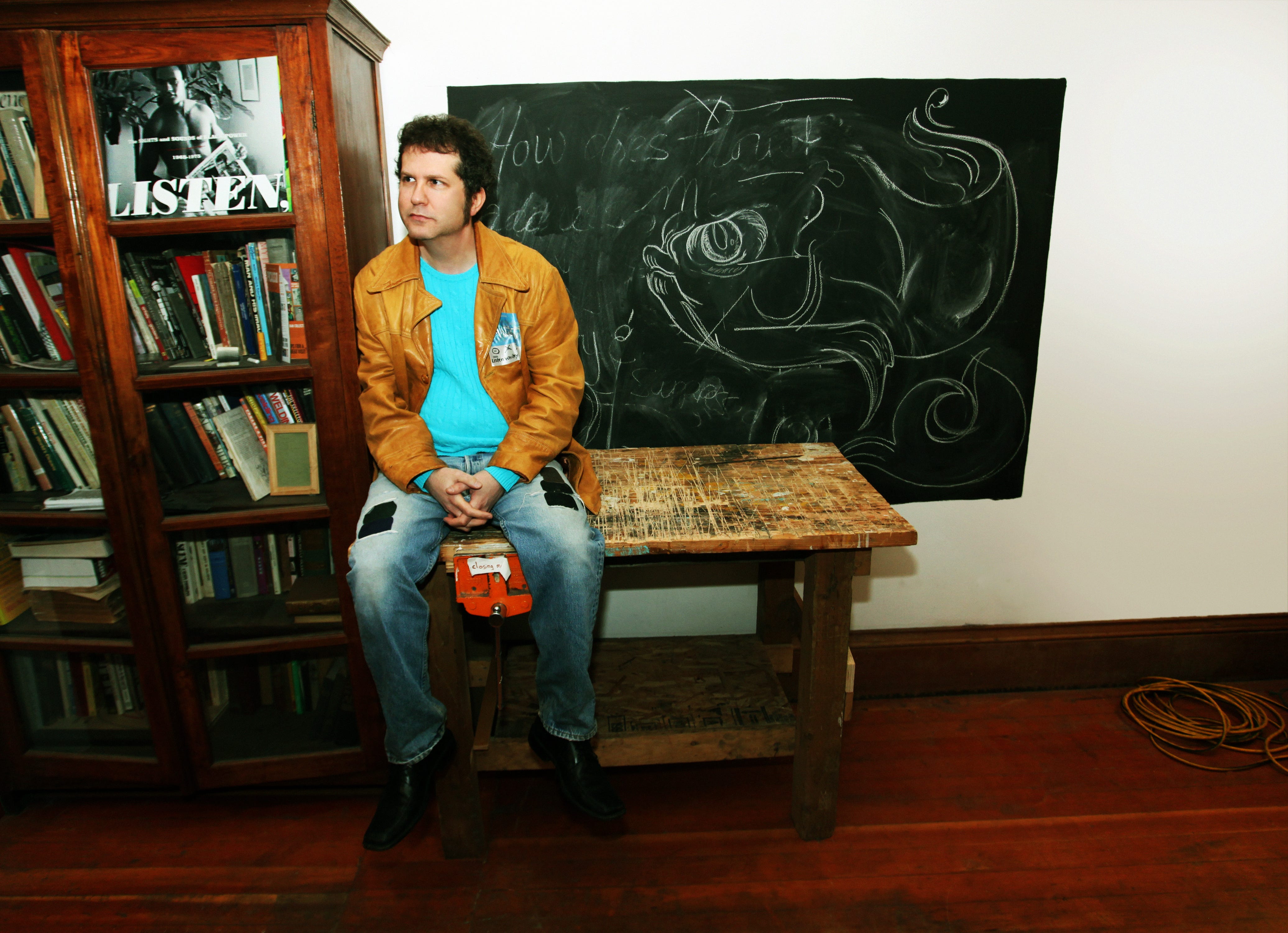
Pictured above: Pat Thomas, author, musician, record producer. Image: ©Kelly O
LH: Which members of the original Beat community or their successors have you met? Tell us about some of your favourite encounters…
PT: In October 1985, I made a pilgrimage to Jack’s hometown of Lowell, MA. I met 80-year-old Father Spike Morissette, who gave me a personal Kerouac tour. Jack was an altar boy when he went to Spike in his youth and said, ‘All the other kids are laughing at me because I want to be a writer.’ Spike told him: ‘Ignore them and just keep writing.’
Years later, in 1969, Father Spike gave the sermon/eulogy at Jack’s funeral. Spike was also a life-long honorary chaplain in the French Navy - so, at the end of a big meal and drinking session, he said to me, ‘We’ll put this on their tab’ – and so he did. I’ve been carrying Father Spike’s business card in my wallet ever since.
LH: You mentioned your interview with Ginsberg. I was fascinated to read in that interview that he performed on stage with the Clash in 1981, something I didn’t know about. Do you think – many others have suggested this over the years – that on some level Allen was a wannabe rock star?
PT: He was not a ‘wannabe’ – he was a rock star! Anyone who gets asked by Dylan and the Clash to share the stage with them – as well as record with them – is a rock star. He’s more deserving of that status than any member of REO Speedwagon, Styx, Tears for Fears or Oasis!
LH: You yourself have worked in the music business as an A&R consultant, reissue producer and liner writer for the likes of Light in the Attic Records and Fire Records. What does being a reissue producer involve? Of which projects are you most proud?
PT: Being a reissue producer is like being a psychologist – you need to know what makes artists say ‘yes’ to a project that you suggest to them. Not every musician is about ‘the money’ – it’s often more complex: they feel forgotten or ignored – or perhaps I understand something about their art or their journey that others have overlooked or even belittled.
I have worked with some interesting and inspiring people like Elaine Brown of the Black Panther Party, Amiri Baraka, Gene McDaniels, the Watts Prophets, Abioudun of the Last Poets, Tom Rapp & Pearls Before Swine – and also the estates of Tim Buckley, Judee Sill and, of course, Allen Ginsberg.
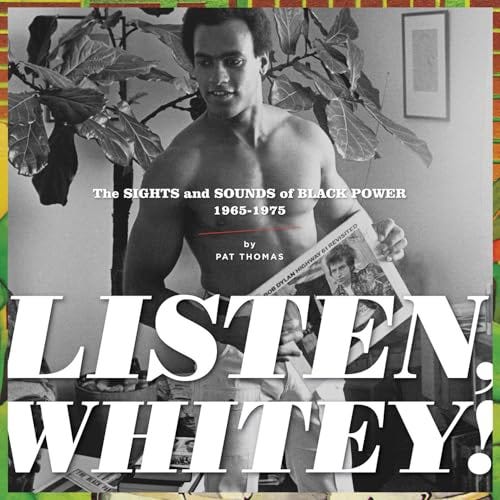
Pictured above: Thomas’ 2012 volume on African American political music
LH: You’ve also had life as a musician yourself. Tell us about the projects you have involved yourself in…
PT: During the 1980s, I drummed with a band from Rochester, New York called Absolute Grey (our sound was kind of like early REM with a female singer coupled with Jefferson Airplane filtered through Echo & the Bunnymen - and yes, we played all original music, not cover songs).
We released several albums and shared stages with bands like Rain Parade, Dream Syndicate, Long Ryders, and Alex Chilton.
In April 1985, we played at the legendary CBGBs club in New York City and that performance is coming out soon as a CD on a label called Heyday Again.
In the mid-1990s, I started an all instrumental psychedelic-jazz-rock outfit called Mushroom. I am the drummer and bandleader – we have released 15 albums (on many different labels) in the past 30 years that blend influences such as Soft Machine, Caravan, King Crimson, Miles Davis - in some ways, Mushroom’s music is a reflection of my love of the writing of Ginsberg and Kerouac. It’s expressive and free flowing.
We have collaborated with Kevin Ayers of Soft Machine, Daevid Allen of Gong, and Krautrock legends Faust. We also once backed up poet Pete Brown (known for writing the lyrics for Cream).
LH: Do any of your favourite musicians or bands link in any way to the Beat ethos?
PT: For sure, some of my favourites do – like Dylan and Van Morrison and Joni Mitchell – but also jazz musician Todd Cochran (some of you know him as Bayete). And I would certai arenly add Mike Scott of the Waterboys, who pulls from a wide and deep well of literary and counterculture references.
Sometimes that carries over into newer bands/new recordings- such as Scott and the Waterboys’ recent album that was a tribute to the life and times of Dennis Hopper - I did NOT play on it - but I was behind the scenes helping out with some ideas and whatnot.
That led to me touring with the Waterboys as they performed their Dennis Hopper rock opera across America – I was showing vintage Hopper images behind them while they played. I have other upcoming adventures with the Waterboys – most notably, I will be recording an album of my poetry accompanied by their keyboardist James Hallawell on piano.
Pictured above: Jerry Rubin’s life related in Thomas’ 2017 release
LH: In Listen Whitey! The Sounds of Black Power, you examine recordings – speeches, interviews and music – from the likes of Huey Newton, Bobby Seale, Elaine Brown, etc., as well as the forgotten history of Motown Records. How long did that project take to pull together? Were you happy with the finished book?
PT: That was about five solid years of research: reading, listening, interviewing. For a first book, written by a middle-class white guy from rural New York State, I’d like to think I did a pretty good job. I was proud of the fact that despite there being dozens of books about Motown – by many ‘experts’ – none had written more than a sentence or two about Motown’s Black Forum label.
That label had so much culturally and politically rich releases. I wrote about 40 pages on just that topic and tracked down much lost information.
LH: Your biography Did It! about political activist Jerry Rubin was described as ‘an unconventional tribute to a supremely unconventional character’. I became quite fascinated by Rubin when I wrote an essay about the 1968 Chicago riots. What drew you to Rubin as someone you wanted to write about?
PT: That came about from the fact that I realized that there were already about six books about his pal and fellow Yippie Abbie Hoffman, and none about Jerry. And also, all of these Abbie books barely mentioned Jerry – it would be like writing a John Lennon biography and mentioning McCartney half a dozen times for a sentence or two at best. That was lame, I thought – and Jerry’s family and friends agreed.
I interviewed 75 people for that Rubin book. Don’t get me wrong, I don’t think my books are ‘amazing’ or ‘genius’ – I just tend to focus on stuff that everyone else ignores.
My Rubin book has about 40 pages of information about John & Yoko in New York City, 1971-72, that no Lennon or Ono biography has touched. It’s like every other writer is scared of embracing their political period. Which is weird. They hated Nixon and the Vietnam War – didn’t you hate that, too?
LH: How relevant are the Beats and the counterculture in the new millennium? Is there an ongoing legacy, do you think? Are some of those mid-century attitudes they projected outdated or does their essential spirit continue to resonate?
PT: No, they are NOT outdated – but sadly, the general public does not give a shit about the Beats, the counterculture, etc. I have travelled extensively throughout America, and to a slightly lesser degree in the UK and Europe, promoting and discussing my books, and the people who come to the events are passionate, educated, curious – but the numbers tend to be quite small.
I’m not expecting to a fill a football stadium (ha ha), but I often see 50 people when I think at least a 100 people should be, or could be, interested in this topic or that topic.
There are some younger musicians who have picked up some Beat influences and injected that into their music – folks like Devendra Banhart and Andy Cabic.
I think that some college kids are still picking up a Kerouac book or two along the way or perhaps reading ‘Howl’ for the first time and that’s cool. But nothing like it was decades ago. I know I’m sounding a bit hopeless right now but I’m writing from Donald Trump’s America – so there’s that!
I love that Rock and the Beat Generation and several others, like Beatdom literary journal, are doing what they do – just like I do what I do by writing my books – but I’m feeling a bit despondent about our efforts right at this moment. But then again, I was on stage in San Francisco at The Chapel for the Ginsberg 100th birthday celebration and the place was packed.
A young poet named Trevor Wedge walked through the audience handing out free copies of his debut poetry book titled Pleasant Warnings for the Wicked – this kid temporarily restored my faith in young people – so I wrote him a fan letter the very next day.
I strongly suggest that anyone and everyone reading this send Trevor an email at tmwedge@gmail.com and he will send you a free PDF of his book.
LH: What, for you, is the biggest misunderstanding people have about the Beats and the Counterculture?
PT: Ah, the usual – that they were dirty, unscrubbed beatniks! All kidding aside, the usual garbage like Kerouac was a right wing nut bag (his views were multi-layered and clouded by booze), Ginsberg hated women (he didn’t), that they weren’t woke or politically correct by 2026 standards. Nobody from the past can live up to the standards of today.
They were artists – artists are complex, many-layered, their politics and their art don’t always sync up or blend like we’d think they would.
LH: Have you ever found material that made you rethink your understanding of a particular writer or artist?
PT: Almost too many times to mention – like the vast amount of stuff in the Ginsberg archives at Stanford University that I crammed into my Material Wealth book. Same with Jerry Rubin’s archives that his family kept – lots of journals with self-reflection and self-doubts and personal awareness that some folks think he didn’t have.
LH: Which lesser known figures in the Beat Generation and the Counterculture do you think deserve more attention?
PT: Jerry Rubin, of course, Elaine Brown of the Black Panther Party. Despite his fame, I can’t believe that nearly every bookstore in America that I visit has no Gregory Corso books. How many of his books are even currently in print? Terry Southern needs some more love – thankfully his son Nile keeps working on that.
LH: With Material Wealth: Mining the Personal Archive of Allen Ginsberg, did you come across material that other scholars have chosen to avoid? Why do you think they did that?
PT: As I mentioned above, talking about John & Yoko – other writers tend to avoid the late 1960s/early 1970s anti-Vietnam War stuff, the anti-Nixon stuff – so my Ginsberg book is packed with evidence of the 1968 Democratic Convention protests in Chicago and other related Yippie and White Panthers material, like John Sinclair of the MC5. Ginsberg was a Yippie!
Folks also ignore Allen as a singer/songwriter which I don’t understand. I love it. In terms of my relationship with the Ginsberg Estate, that really came about because I was into Allen as a singer/songwriter – I eventually reissued the First Blues vinyl LPs on CD.
So, rather than be just another fan wanting to discuss Allen’s poems – I became known as the ‘Allen music guy’ – I assembled a two CD version of what was originally a single LP of Allen’s Songs of Innocence and Experience. All of my Ginsberg projects are because Peter Hale of the Ginsberg Estate, who really believes in my vision and is always beyond helpful. I love that guy.
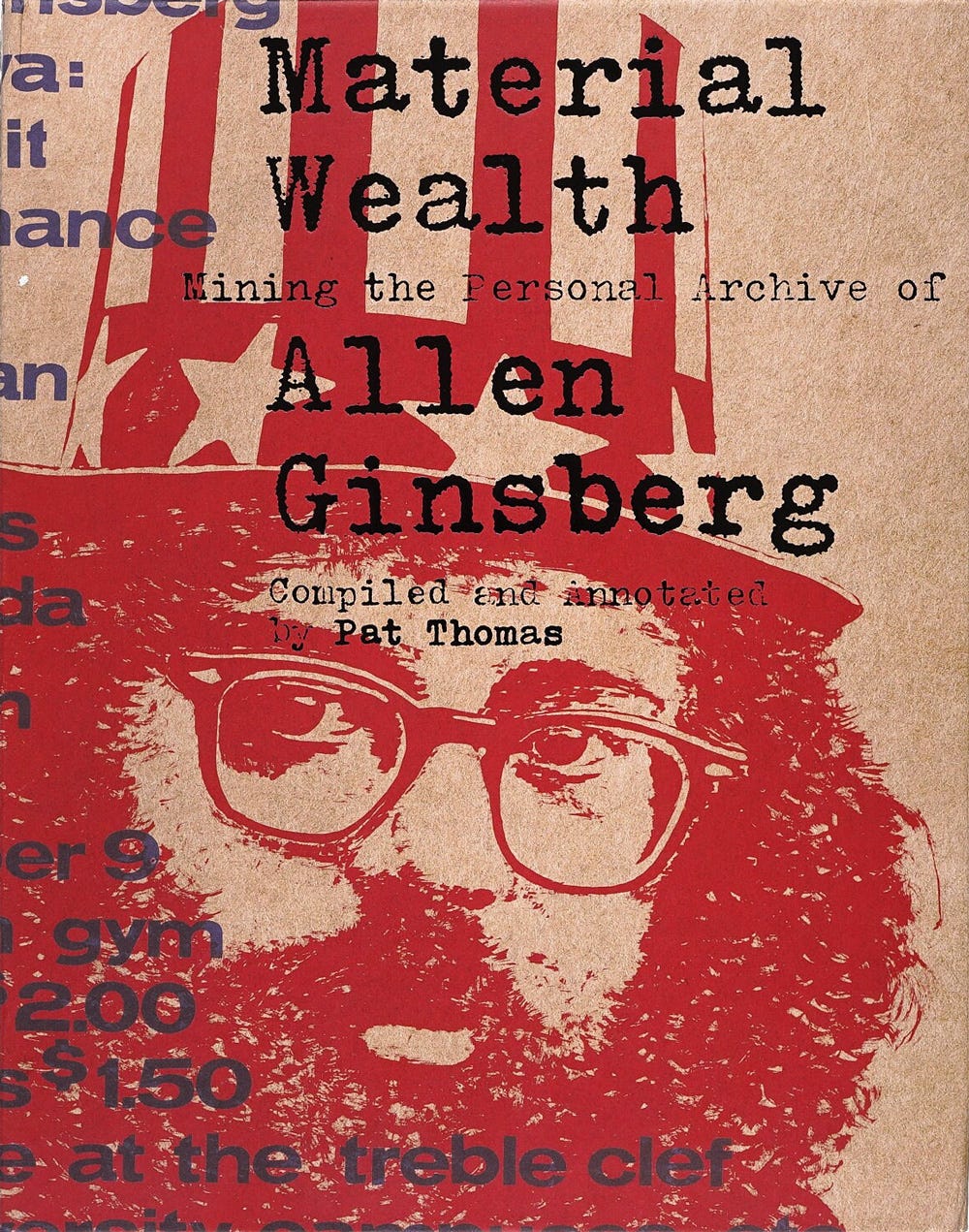
Pictured above: Material Wealth tapped into the vast Allen Ginsberg archive
LH: Have you ever encountered legacy gatekeeping that has overshadowed or damaged a writer or musician’s reputation?
PT: I wish the Sampas family had embraced Jan Kerouac as a writer and welcomed her into their family. Connected to that, Gerald Nicosa wrote the best biography of Jack, Memory Babe – he should be celebrated, not ridiculed. All that said, I think that a younger member of the Sampas family, Jim Sampas, is doing a fine job keeping things going – many new Jack Kerouac books and projects happening. I like Jim a lot.
LH: Evergreen Review: Dispatches from the Literary Underground, Covers and Essays 1957-1973 is a remarkable collection, a welcome history in facsimile of the radical magazine edited by Barney Rossett at Grove Press. How did you hit on the idea?
PT: To paraphrase the original and best Bobby Kennedy: ‘Some people look at things and say “why?” and I look at things and say, “why not?”’ My main aim is do books not previously done – hence, as much as I love Dylan or the Beatles, for example, I wouldn’t do a book about them. And if you are gonna cover those types of folks, find a new angle, please.
LH: Is there a current project you’d like to tell us about?
PT: Well, I am almost embarrassed to bring this up as I’ve been promising it for many years – it’s my song-by-song/album-by-album look at Van Morrison’s music.
For years, I have been working on this look at Van Morrison – it’s NOT a biography, it’s NOT gossip about his complex personality, it’s my thoughts and feelings about his ethereal, evocative, spiritual music.
The book is titled Listen to the Lion: Musings on Van, his Band & Street Choir and I encourage all of you to put that title into your Facebook search engine and check out my special page about the book. I hope to finish this book next year.
The new book simply gathers my thoughts on his music, inspired by what my friend Paul Williams, founder of Crawdaddy, the rock magazine of the mid-1960s, did with his multi-volume Bob Dylan series of books.
He just listened to albums and live tapes and reflected on how they made him feel. Paul is gone now but I wrote something about him for NPR (National Public Radio) when he died.
LH: Thank you, Pat, for sharing so much interesting information and background…
See also: ‘Generation Beat #2: Daniel Yaryan’, April 5th, 2026; ‘Generation Beat #1: Brian Hassett’, February 28th, 2026; Book review #42: Evergreen Review’, March 8th, 2025; ‘Book review #20: Material Wealth’, December 15th, 2023
About the interviewer: Leon Horton is a UK-based countercultural writer, interviewer, and editor. He is the editor of the acclaimed essay/memoir collection, Gregory Corso: Ten Times a Poet (Roadside Press, 2024), and interviewer of authors Victor Bockris in The Burroughs- Warhol Connection (Beatdom Books, 2024) and Stewart Meyer in The Bunker Diaries (Beatdom Books, 2025). A regular contributor to Beatdom literary journal, Rock and the Beat Generation and International Times, his essays, features and interviews have also been published by Beat Scene, Erotic Review and Literary Heist.
 | A guest post by
|
What a fantastic interview. Thanks for the stimulating read.
Really enjoyed this! Beyond all the beat books, glad to learn of Pat’s coming Van Morrison book. His 60s-80s mystic music, incredible still.
I met him a few times, in SF, LA, Marin, Ireland. Always interesting. Following that page on FB now and will look forward to book and hope to see you at Counterculture Museum again!
(Here’s my minor contribution to Van lore: The Old Weird Ireland and The Young Weird California: Van Morrison As Channeled By Greil Marcus https://theava.com/archives/7088