
Recalling James Grauerholz
Ginsberg sideman on Burroughs aide
‘First thoughts on hearing the news of James Grauerholz’s passing, January 2nd, 2026’
By Steven Taylor
MY MAIN IMPRESSION over the years was of James’ kindness. It always came a little bit as a surprise because I knew what he was up against as William’s protector, and I was in awe of Burroughs, but Jim always came across as thoughtful and generous with me.
In the summer of ‘79, after touring for several months with Allen, I went from Amsterdam to Boulder, Colorado ahead of him, to prepare for the Naropa Summer Institute. I was to study music with the band Oregon; my girlfriend Maria would study dance with Barbara Dilley (of the Merce Cunningham Company), and we were to be the sole teaching assistants in the Writing Program, ministering to a new crew of poets and writers each week for four weeks. It was completely mad.
Shortly after I arrived, Allen called and said that Burroughs would need my help. I had met William briefly backstage at the Nova Convention six months prior. Allen said, ‘Bill, this is Steven Taylor. He’s English.’ ‘Well good for you, Allen,’ he said, ‘got yourself an Inglish boy.’
That June, William arrived at the apartment block across the street from mine, and I went over to see if he needed anything. The first thing was to take him to the Liquor Mart, a supermarket that had been converted into selling only booze. At the time it was a novelty, an acre of bottles and buying liquor with a shopping cart. William wheeled the cart, surveyed the aisles, and selected a large bottle of rum.
When he phoned, Allen said that some books would be delivered for William to sign, and I should assist him with that. It was the new, pocket-sized, hard-bound edition of Blade Runner. We sat at the dining table and he signed several crates of books with a black Sharpie, a broad felt-tipped marker with permanent ink. Subsequently, I received a letter from James (there was no email at the time) with detailed instructions on the kind of pen to use, and where to have him sign. I had gotten it all wrong and freaked out that I’d blown it, but when Jim arrived in town, he relieved my anxiety instantly.
He was a large man, well-proportioned and fair, with mild features, a kind face and formal manners. A midwestern gentleman, a softer version of his boss. I confess that I pictured him at the time on an old poster as the epitome of Aryan masculinity, except there was nothing macho or severe about him. He looked preppy to me, immaculately dressed in a polo shirt, tennis sweater, jeans, and white tennis shoes. We clearly came from different planets, but he put me at ease immediately.
He must have come to my place because the next thing I remember is that we were trading songs, passing my guitar between us. His songwriting was impressive, he was way ahead of what I was doing at the time.
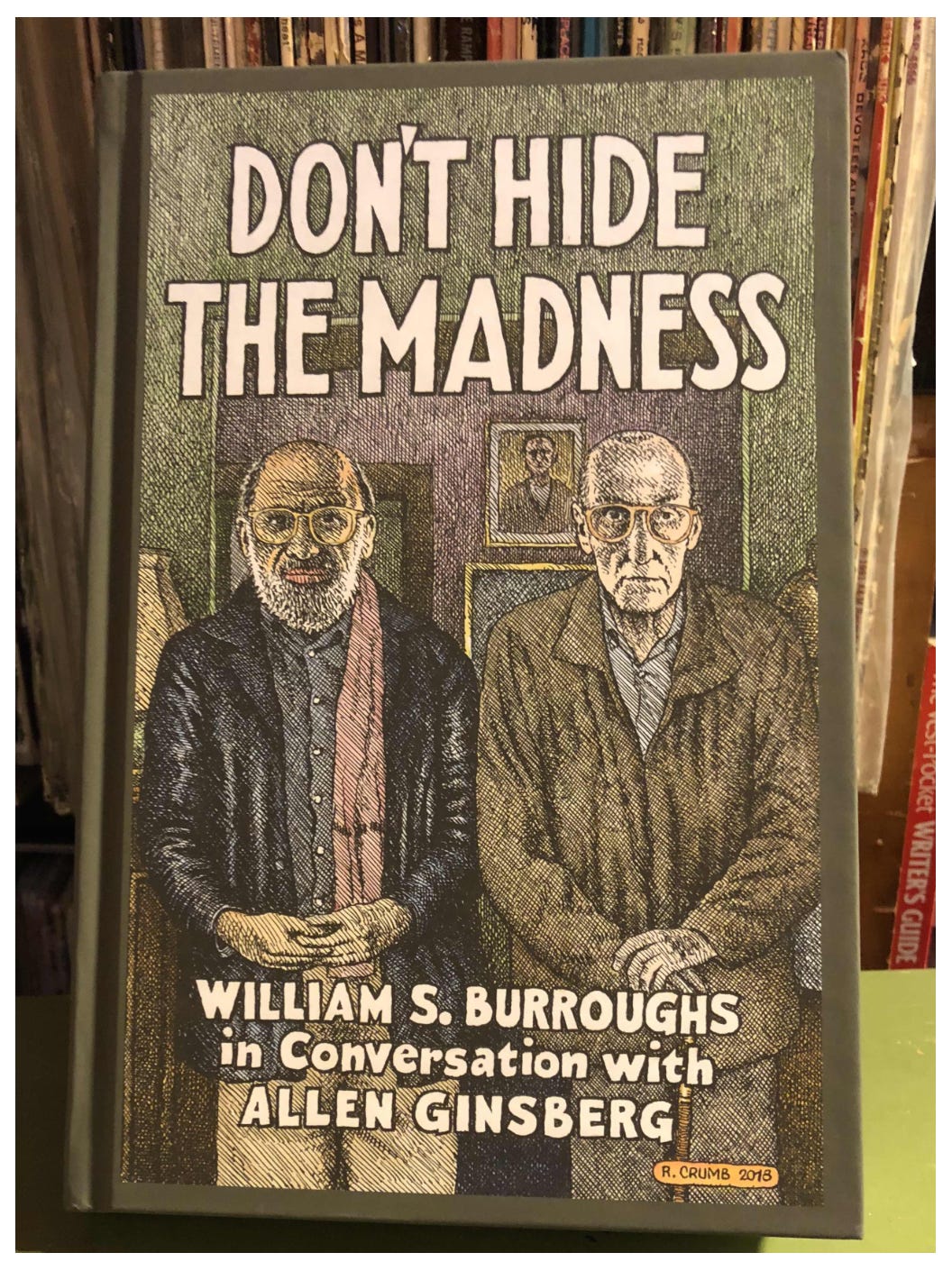
Pictured above: Steven Taylor’s edited 2017 edition of Burroughs and Ginsberg’s exchanges. Taylor and Grauerholz performed the conversations together on stage
We spoke occasionally during the years that I was assisting Allen’s secretary Bob Rosenthal, in the apartment office at 437 East 12th Street. But we really connected at a conference of the American Studies Association in the late-90s, after Allen and William were gone. He presented his terrific study on the death of Joan Burroughs, after which we had dinner together and talked about our very small club of guys who looked after Beats.
Oliver Harris mentions Jim’s frustrations. I can relate. I sometimes wondered what I might be doing if I had not been working with Ginsberg, and James’s involvement with William was much more immersive than mine with Allen. Jim was full-time from 1974 until yesterday. Oliver mentions people criticizing James for steering William in particular directions. That is the price of being amanuensis to an icon. Everybody’s an expert and you’re always wrong.
I always admired James for his care of William. He was just so smart and discerning and caring. He very likely added 15 years to William’s lifespan by rescuing him from the Bowery bunker where junkies were lining up for bragging rights about having shot scag with el hombre. And it must have been James who arranged for William to have his ‘Ugly Spirit’ exorcised in 1992 by the Navajo shaman Melvin Betsellie.
At that point, Allen asked me to transcribe a dozen cassettes of conversations he’d had with William at the time of the exorcism. The purpose was to yield a few hundred words for an article for the London Observer to coincide with the pending European release of David Cronenberg’s Naked Lunch film. James had warded off interviewers, since William had had heart surgery some months before, and Jim didn’t want him to have the stress of visiting journalists. Jim agreed to having Allen visit to record a conversation about the film. That conversation ran to four days, 16 hours of tape, and some 300 pages of script. A small piece of that transcript informed an article in the Observer magazine that spring (April 26th, 1992).
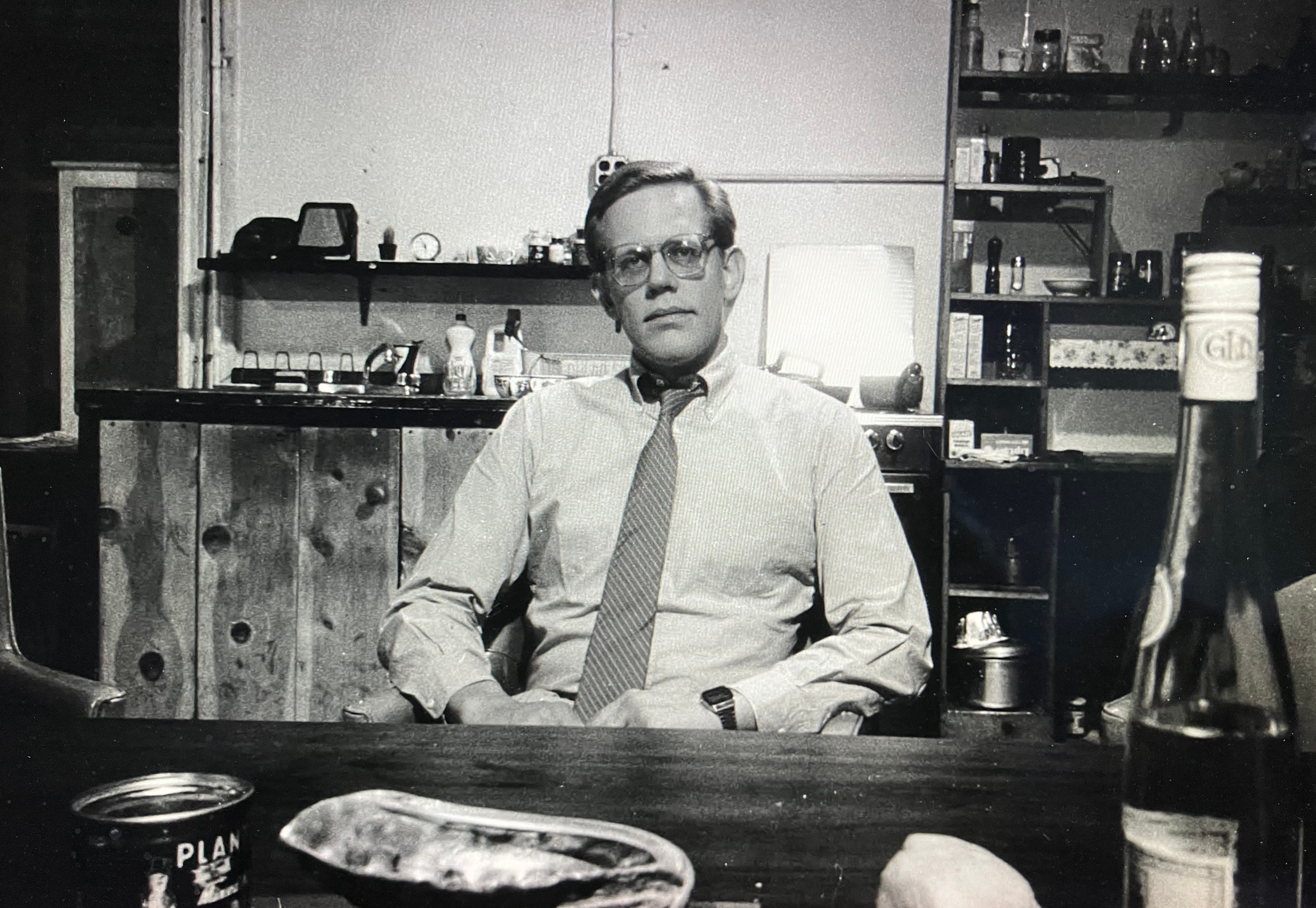
Pictured above: James Grauerholz in the Burroughs Bunker, photographed by Allen Ginsberg, 1984
In 2014, going through a box of old manuscripts, I came across my original typescript. Peter Hale at the Ginsberg office scanned it for me, and pitched it to James, saying I wanted to make a book of it. Given his protectiveness of William, I expected him to disapprove, but again, his response came as a pleasant surprise. ‘We love Steven, let him do it.’ I named the book Don’t Hide the Madness (Three Rooms Press, 2017), taking a line from Allen’s 1954 poem ‘On Burroughs’ Work’. James weighed in helpfully at various points in the process, and he couldn’t help a small dig, referring to the project as Don’t Hide the Mattress.
Once the book was out, my publishers Kat Georges and Peter Carlaftes arranged for us to do readings from the book at City Lights in San Francisco and at the University of Kansas, in Lawrence. James was our host in Lawrence, where we stayed at the Eldridge Hotel. At our university reading, James read the Burroughs part of the script, and I read Ginsberg. It was, as he might have said, a hoot.
I hadn’t seen Jim since he moved back to Kansas, but he was as warm and witty as ever. William’s house – a 1920s mail-order bungalow from Sears – was still there, cared for by a friend. Jim lived nearby in a house with a large study and storage room with library-style bookshelves and cabinets containing William’s papers. A few friends lived nearby, some of whom had been part of William’s circle in Lawrence. The whole scene was very friendly and appreciative. James was having some health issues, but seemed overall to be in good spirits. That was near a decade ago, and it was our last contact.
Now I have to go clean my study, find a photo of James, and light a candle.
Editor’s note: Steven Taylor is a musician and writer. From the the mid-1970s to the mid-1990s, he was Allen Ginsberg’s guitar accompanist. He has been a member of the Fugs for four decades. He regularly contributes to Rock and the Beat Generation
See also: Burroughs specialist Oliver Harris’ tribute appeared in R&BG yesterday. Visit ‘Obituary #8: James Grauerholz’, January 2nd, 2026
In the early 70s I was Allen's secretary. I understand how both of these men felt (feel). Reading all the remembrances has been trying. This one has been beautiful. I had to have met Steven in the 60s because I met the Fugs then.
A lovely, literary remembrance. The abstract theoretician in me wonders what we're the big picture lessons of the by-gone years from the world of Burroughs, Ginsberg, Kerouac et al? Having done an excruciating chapter on James Baldwin--"The Loneliness of the Long Distance Leader for Racial Justice--I've slowly rid my habits of the "theoretic."
I'm now into the "real work" that the off Beats, Snyder & arguably
Alan Watts as well, what were the maddest Beats all about. The Naropa Institute is instructive, yet somehow feels esoterically lacking. Where's The Rub. Don't mean this in a pejorative way, just asking. Nearly 60 years after reading Watts's," THE BOOK: On The Taboo of Knowing Who You Are," and Snyder's, "The Practice of the Wild" are there any connections to the Running Wild allies, who seemingly dwelled in drinking, coke, etc? Both Timothy Leary and Ram Dass (AKA, Richard Alpert) in differing spiritualities, not unlike Jiddu Krishnamurti took many of us on a jet ride to a seeming higher, yet "grounded" path to the Self. My gut tells me that the strangers who became friends for three days in the Catskills in '69, whom Joan Didion and even one of my heroes, James Baldwin, disdained are still seeking that "Magic Carpet Ride."
I know I am....