
Interview #51: Gordon Ball
Photographic memories

GORDON BALL has led several lives, as educator and photographer, filmmaker and friend plus confidant of the Beat Generation writers, in his 81 years on the planet. Since the mid-1960s, when he first encountered Allen Ginsberg, he has had regular connections with the key figures in that movement and, as a skilled cameraman, framed vital memories of a key literary circle and their associates in hundreds upon hundreds of shots.
The grandson of a portrait photographer, he was born in Paterson, New Jersey, but grew up in Tokyo, Japan, where he first picked up a camera. His skills with that device proved formidable and a vast body of work has been accumulated and shown in many exhibitions over the decades since.
As well as being seen at numerous conferences on Ginsberg and the Beat Generation, his work has been presented at one-man shows at the Southeastern Center for Contemporary Art in Winston-Salem, North Carolina, and other venues, and his photos have also appeared in multiple books.
Among the titles to have incorporated his images are Dennis McNally's Desolate Angel: Jack Kerouac, the Beat Generation, and America; Rick Fields' How the Swans Came to the Lake: A Narrative History of Buddhism in America; Michael Köhler's Burroughs: Eine Bild Biographie; Carole Tonkinson's Big Sky Mind: Buddhism and the Beat Generation; Steven Watson's The Birth of the Beat Generation: Visionaries, Rebels, and Hipsters, 1994-1960; and the Rolling Stone Book of the Beats.
In addition, he is an award-winning filmmaker, creating a series of independent movies which have been shown at such institutions, as the Museum of Modern Art, the San Francisco Art Institute, Anthology Film Archives and the Guggenheim Museum.
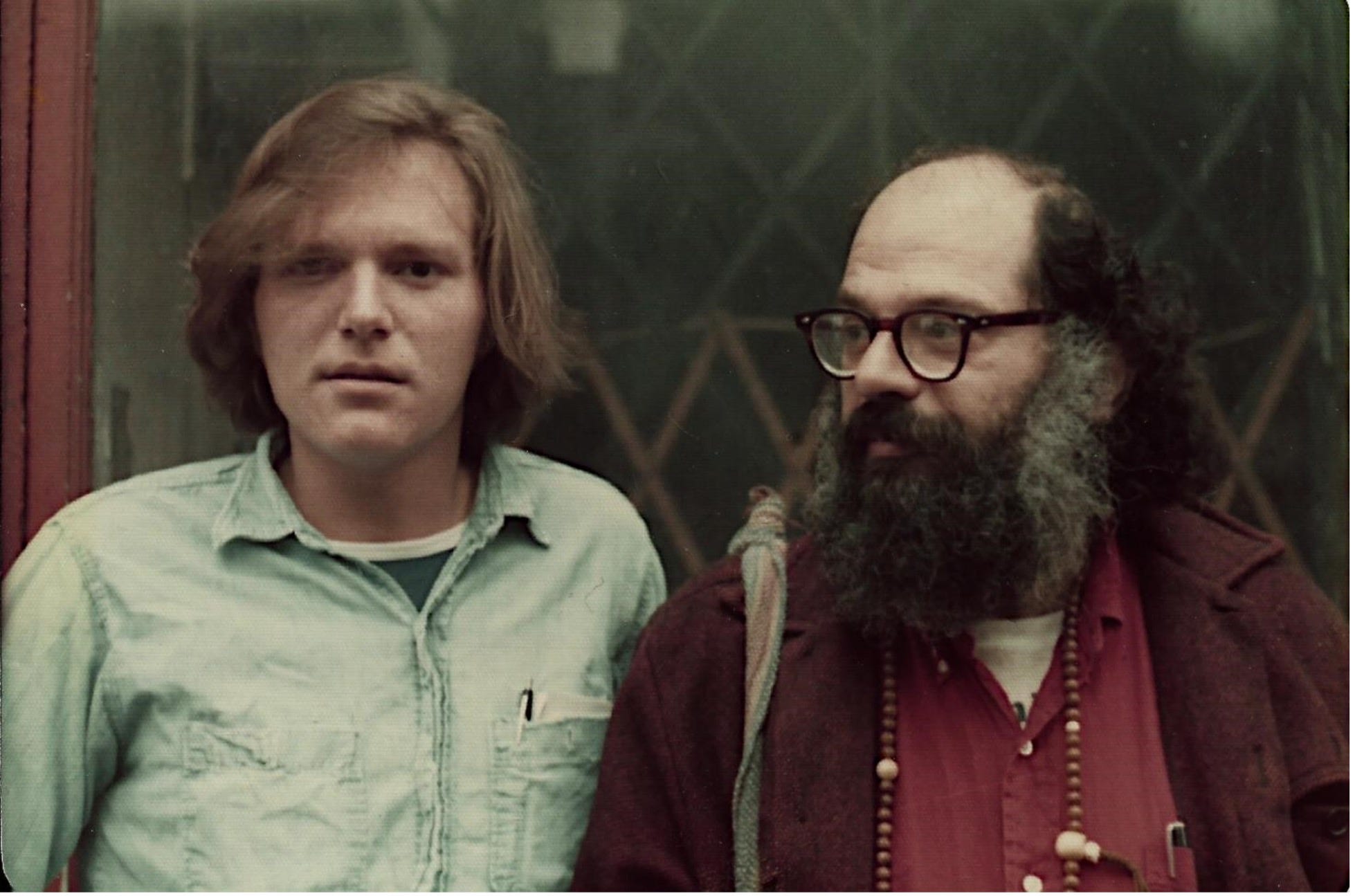
Pictured above: Gordon Ball and Allen Ginsberg, New York City, November 1974. Photograph, Denise Mercedes
Ball’s latest publishing project is Ginsberg & Beat Fellows: A Personal Record, Photographs 1966-2022, a volume which features unique images of Ginsberg and his close companions – Peter Orlovsky, William S. Burroughs, Herbert Huncke, Carl Solomon, Gregory Corso, Gary Snyder, Andy Warhol, Anne Waldman, Bob Kaufman, Jonas Mekas, Lawrence Ferlinghetti and others.
Bill Morgan, long-time Ginsberg associate, has penned an introduction to the new title, commenting: ‘Once in a very long while someone will come along with a camera and find themselves in the right place at the right time to record history as it unfolds. We are lucky that Gordon Ball is such a person. On the surface, he appears to be a shy man, a quiet and unassuming man, but his path has crossed with some of the greatest authors of our generation.
‘But witnessing history is not the same as capturing it artistically, and we are fortunate that not only is he talented as a photographer and a filmmaker, but he is also gifted with an aesthetic eye. Not only are his works important as documentary records, but he is able to turn his compositions into exquisite works of art. They have a certain aesthetic quality that transcends time and gives us a hint as to what it was like to be part of a vibrant, creative period in American literature.’
And the great Beat Generation scholar and historian Ann Charters has herself praised the pictorial anthology: ‘Gordon Ball’s marvellous images in this book are the most poetic ever created by a Beat photographer. His portraits are visual metaphors, illuminating the soul of his subjects in tender, revelatory moments captured on the page for eternity.’
Ginsberg & Beat Fellows: A Personal Record, Photographs 1966-2022 has just been published by the Richard W. Couper Press, Hamilton College Library. Rock and the Beat Generation’s Founding Editor Simon Warner recently had the great pleasure of catching up with Gordon Ball to discuss his life and work and his enduring connection to the Beat family…
__________________________________________________________________
Simon Warner: Hello, Gordon. It’s tremendous to connect with you. First things first, did you actually train as a photographer?
Gordon Ball: No. My grandfather took photographic portraits, but closed shop before I knew him. I grew up in Japan, where cameras were everywhere.
SW: You were heavily involved in education for many years. What did you teach in colleges and universities?
GB: Quite a range of things. Composition; Film History and Theory; American Literature in various periods; a seminar on Whitman’s Leaves of Grass. Literature of the Beat Generation.
SW: How do you first become associated with the Beat Generation writers?
GB: I met Allen at a party at Panna Grady’s 1966, but did not do so effectively until Barbara Rubin got us together on the farm she was getting for Allen in upstate NY 1968. Our first meeting was actually depicted in the book ’66 Frames.
SW: When did you first really connect with them and how did you become integrated into that circle?
GB: Peter, Gregory, many others, came to East Hill Farm, as covered in book of that title.
SW: They obviously came to trust you as a cameraman. How did you build their trust?
GB: I don’t know that I built it. At the farm, we had a common purpose; working with Allen on books, as Bill Morgan says in his introduction to the new book, I was seen as a friend, not a photographer from outside.
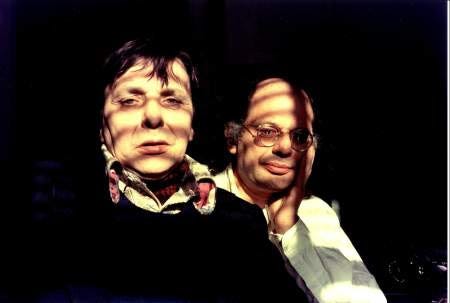
Pictured above: ‘Huncke with longtime supporter Allen’, around New Year’s 1976. Photo by Gordon Ball, ©Gordon Ball
SW: Material in the new book covers a very long period. How many pictures are featured and how did you go about selecting them?
GB: I think over 200. Mainly as to whether they seemed of aesthetic or documentary value.
SW: Are some of these images being seen by the public for the first time?
GB: Yes, many.
SW: What are your favourites? Of which you particularly proud?
GB: I have many favourites – of course some of the best-known (e.g. Cadets Read Howl, Bathing Beauties; Huncke & Allen), as well as certain oddities like the gesture by Julius Orlovsky in front of the Mafia Coffee & Dolls shop; the close-up of Allen with Peter’s hand on his shoulder; my last ‘blur’ shot of A&P.
SW: We should also remind our readers that while you have become well-known for your photography, you have had an important further strand in your career as a filmmaker. I believe you were attending a film program at Davidson College and had the confidence and self-belief to invite underground movie director Jonas Mekas to visit the campus.
GB: For two and a half years as a student I was running the film program at DC, with some showings standard fare (regular Hollywood releases) and others’ ‘Film Friends’ – mainly European recent & classic (e.g. Vertov, Eisenstein). I didn’t know what would happen with Jonas’ coming to campus.
I wouldn’t have known of him, yet alone thought to ask him, had a classmate, who’d just read about him in the New York Times, not stuck his head into my dorm room and suggested I invite him. I then had, as it happened, a meeting with him when I was in NYC at Panna’s over spring break of my senior year. That gave me heart.
SW: Was this an inspirational meeting? Did Mekas have an impact on your own independent film work?
GB: Yes, he was inspiring, and proved very much so in his day-long visit. I wrote of this, in detail, in my ’66 Frames: A Memoir. When I met him at the train in Carolina, he handed me a movie camera, with which I made my first film. He definitely had enormous impact through his presence, his diaristic films (he shot while on campus, spontaneously).
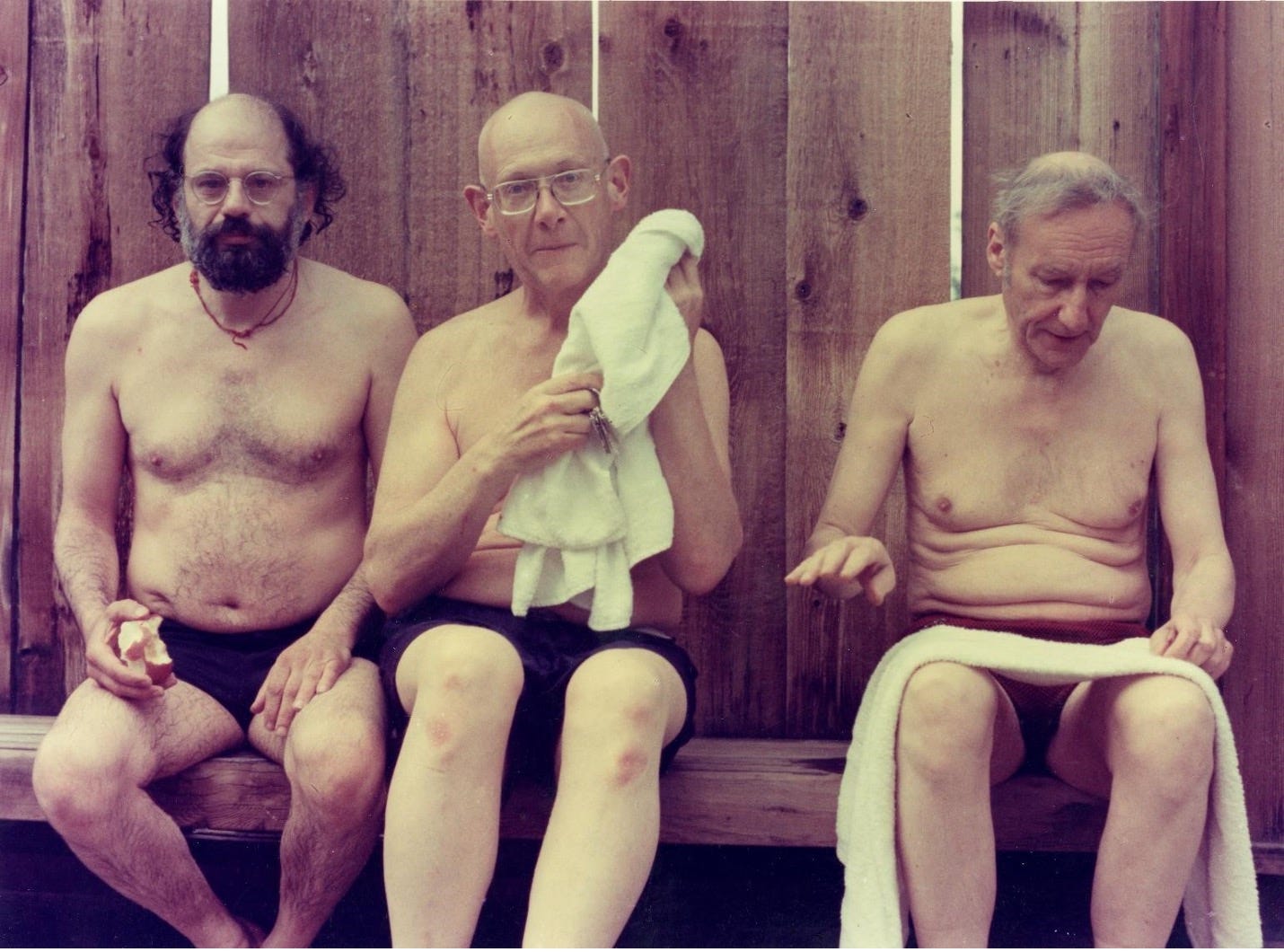
Pictured above: ‘Allen, Philip Whalen, William S. Burroughs, swimming pool area’, Varsity Apartments, 1555 Broadway, Boulder, Colorado, July 22, 1976. Photo by Gordon Ball, ©Gordon Ball
As I wrote at the end of a caption in my photo book, ‘Jonas turned my college experience upside down & brought me a new life; his handing me that magic box led to the creation of a dozen films.’ My shooting has almost always been spontaneous, personal – everyday life including on death of father, jail in Mexico, etc.
SW Are there films you were particularly pleased with?
GB: I favour most of all Enthusiasm (elegy for mother), Mexican Jail Footage (shot inside jail when I was a prisoner, abruptly arrested without charge, and later deported), Millbrook (LSD).
SW: You also met Warhol on your return to New York City. What was that like?
GB: I first learned of Andy in an art appreciation class (1965?), watching footage of him assemble Brillo boxes – how funny, I thought. I met him in NYC ’66 at the Dakota. He invited me to the Factory, had a small role in one of his films, saw each other on and off my year in New York ’67-68 – a chapter and some details in ’66 Frames. Then from time to time over the next decade or so, casually. I always liked him. He’s in the photo book.
SW: Is there a relationship between still photography and capturing moving images or are they quite different skills?
GB: Visually, my Enthusiasm consists entirely of family photos. There’s a relationship between moving and still but they do also involve different skills. I don’t think of myself as particularly skilful!
SW: Bill Morgan compares you to Cartier-Bresson and Robert Frank. How did that connection he makes feel to you?
GB: I was honored, grateful – to say the least!
SW: I’m assuming that you probably knew Robert Frank? Did you – and how did his work influence your own?
GB: I knew Robert only a little; I’m not aware of a direct influence, though I still think of The Americans as the greatest volume by a single photographer. He told me of my MJF, ‘I can’t forget that film.’
SW: Morgan refers to your ‘youthful wanderlust’, hitchhiking across the US and Mexico. How old were you then?
I did some of it during college (from around the age of 18) but the bulk of it at 22-23. I’d read Kerouac’s On the Road early on, but don’t know that I was particularly inspired by that. Hitching was a not uncommon means of transportation for young people and others, for that matter. It was a different day – before interstates prohibited it.
Kristofferson’s ‘Me & Bobbie McGee’ is, for me, an anthem – that ethos, that aura, that come-what-may of hitchhiking. Glorious grunge, if you will.
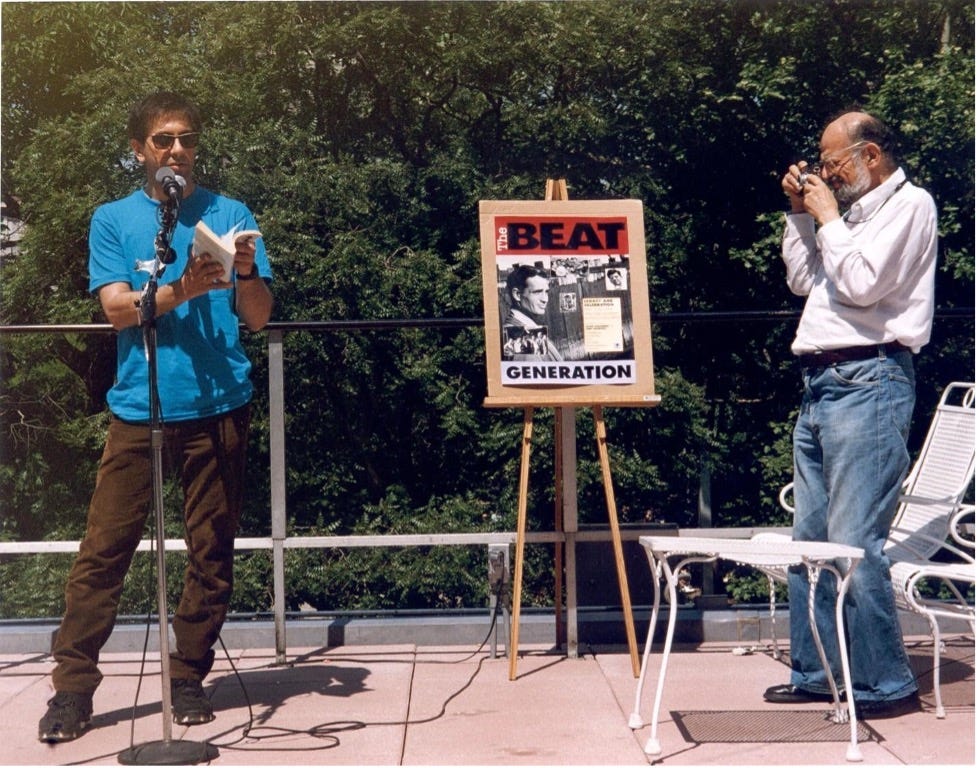
Pictured above: ‘Photographer Allen Ginsberg shoots rock star Lee Ranaldo’. Sonic Youth’s Ranaldo was reading from On the Road during a marathon reading of the novel, New York University, May 1994. Photo by Gordon Ball, ©Gordon Ball
SW: How did working in the academy and mixing with literary rebels co-exist for you? Did the experiences clash or complement?
GB: Well, I tried to make things work. Regularly I gave a course on the Beat Generation (which was formally accepted as an elective within the curriculum), had Allen Ginsberg to campus for nearly a week (a lot on that in photo book); Anne Waldman, David Amram came. (Don’t forget – all this at a military school.)
As you know, I nominated Dylan for the Nobel Prize starting in 1996; when I asked a friend what colleagues thought of my making such a nomination, he politely informed me, ‘You’re a nut.’ (Well, I asked!)
SW: We are particularly interested at Rock and the Beat Generation in the relationship between these radical writers and groundbreaking music makers. Is music important to you?
GB: Music (along with some other influences) keeps me alive! (See my earlier response re ‘Bobby McGee’).
SW: Which genres/artists have had an effect on you as a creative person?
GB: Of course Dylan’s had a great effect, whether the purity of ‘Lay Down Your Weary Tune’ or the nightmarish ‘Desolation Row’. But it’s hard for me to pinpoint influences. I like much else in music, too, songs all over the place, e.g. ‘La Paloma’, some Italian opera, Japanese children’s music, from early days Tokyo.
I would like to be a musician but it’s hopeless – for one thing, short stubby fingers are not suited for guitar. When I tried to learn, a couple of friends indulged me, playing along. I felt making music together was the greatest joy – or, as I saw it in Paul McCartney, solo, in the 1970 film Let It Be, which is no longer available. By the way, I’m (re)reading Miles’s terrific biography of McCartney, which is also inspiring.
SW: Which musicians did you photograph?
GB: Lest we forget, Allen Ginsberg’s a musician too – in a variety of genres! I’ve not photographed any rockers except Lee Ranaldo and Richard Hell plus Denise Mercedes of the Stimulators (all in the photo book). Arthur Russell, too, if you consider some of his work rock, also in the book.
SW: Is your book an obituary to the Beats or do they live on in spirit?
GB: It’s an elegy for that time period. I’m just back from participating in Allen’s Centennial in NYC – yes, they live on in spirit.
SW: Thank you, Gordon, for sharing your time and energy…
See also: See Gordon Ball’s essay ‘Nobel intentions: Dylan and that prize’, October 23rd, 2025, here
Editor’s note: We will review the book Ginsberg & Beat Fellows at Rock and the Beat Generation in the near future
Just wondering if you will ever do an insight into Hershal Silverman who was part of the beat generation with Burroughs in Paris and who sometimes read with Ginsberg
I’m a huge admirer of Dennis McNally and have fond memories of him and his association with The Dead in days of yore. I occasionally had the privilege to share a few emails with Dennis. Altho I lost the contact when my Yahooaccount crash. He was very kind- read my Brautigan tribute Winter Roses which I believe you published and Dennis praised it and told me to continue writing. Your interview with GB was incisive and revealing as were his accounts of the history of his photography and the artists he’s got on film - he indeed captures a generation’ideals Frisco Tony